[mc4wp_form id="1782"]

Old Gems found in Fourteen Great Detective Stories

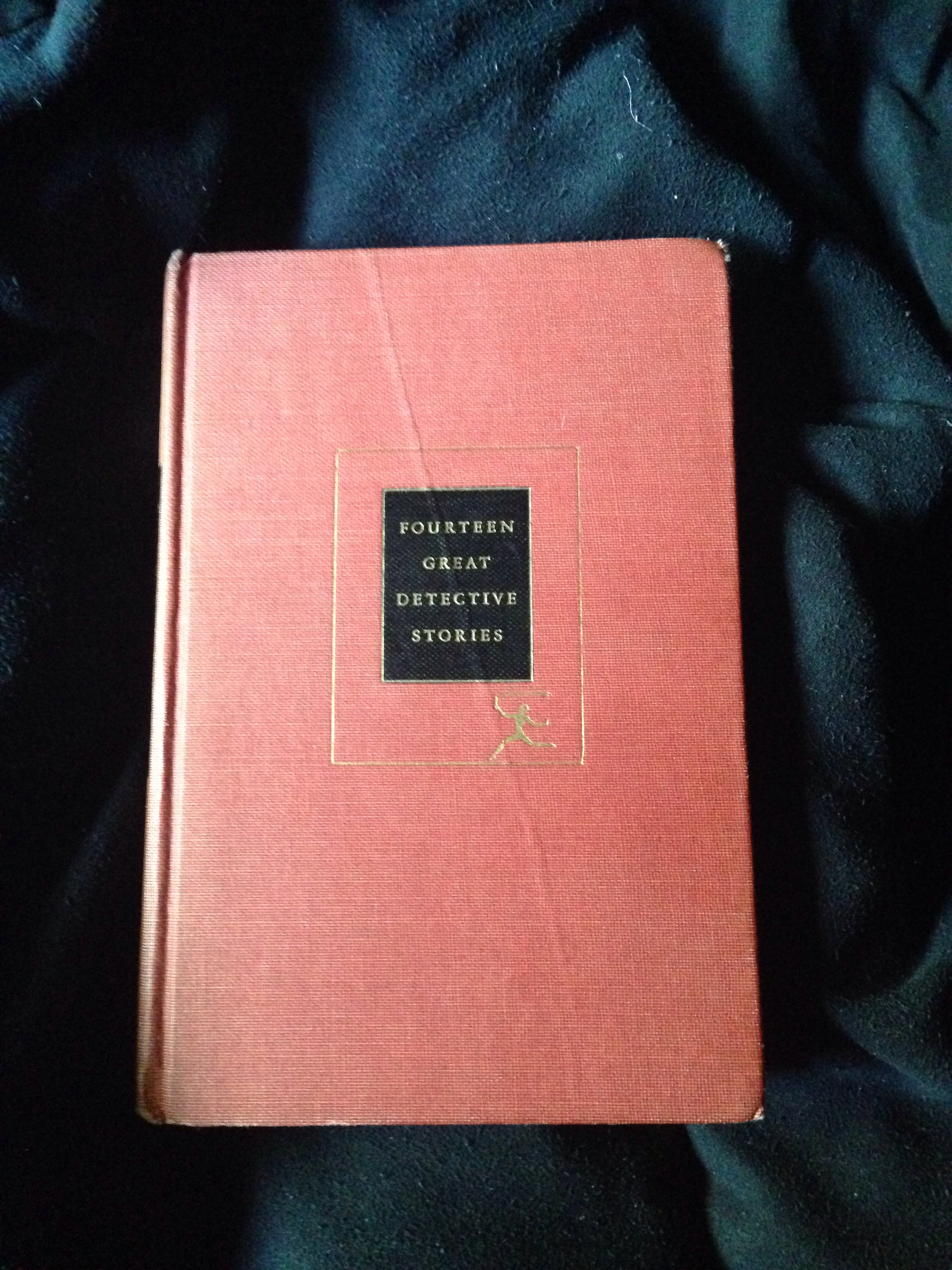
I dipped into this wonderful old anthology over the past couple of weeks.  I once actively collected the Modern Library series, and this book was on those shelves, though it’s in far from collectible condition. It does have a fun old gift inscription and a big old crease through the front board, which somehow makes the book look more friendly.

Earlier I read an essay about how the story The Case of  Oscar Brodski, one of the Dr. Thorndyke mysteries by R. Austin Freeman was revolutionary for being the first We See Who Commits the Crime, Will They Be Caught style of stories.  In old essays about crime fiction, this is often called an Inverted Detective Story.  I had never read Dr. Thorndyke and was not familiar at all with The Case of Oscar Brodski.  Then, VOILA, springing forth from my own shelves, there it was. I think Freeman’s story holds up and was pretty good, even to this modern reader.
However, also in this book, the real treat was Cornell Woolrich’s short story The Dancing Detective.  Wow!  For suspense, menace, and just a straight-up creepy story, what a knockout! The narrator’s voice was so enjoyable, with just the right amount of dark humor. The contemporary slang, also very well done and hilarious. This short story exceeds a lot of stuff coming out today, but then again, Cornell Woolrich is still considered a master of the genre.


The stories included in this edition (earlier editions had slightly different contents):

Bailey, H.C. The Yellow Slugs
Bentley, E.C. The Little Mystery
Chesterton, G.K. The Blue Cross
Christie, Agatha The Third-Floor Flat 
Dickson, Carter The House of Goblin Wood
Doyle, A. ConanThe Red-Headed League 
Freeman, R. Austin The Case of Oscar Brodski
Futrelle, Jacques The Problem Of Cell 13
Poe, Edgar Allan The Purloined Letter
Post, Melville Davisson The Age of Miracles
Queen, Ellery The Adventure of the African Traveler 
Sayers, Dorothy L. The Bone of Contention
Stout, Rex Instead of Evidence
Woolrich, Cornell The Dancing Detective


Powered by Buttondown.

About the Author: Benjamin L. Clark writes and works as a museum curator.

“Bingo.” At the intersection of History & Slang

BINGO

I can get swept along when writing, especially when writing dialogue. I’ve heard this state of writing is called “flow,” which makes sense. Cruising along in my current story, set sometime around 1935, and out of the mouth of one of my characters comes the word “Bingo.”  I’ve never used the word outside the game with the balls and whirly wheels myself, but this fictional gent decided to say it in my story.  It jolted me out of the writing, and I thought: Did anyone even use the word Bingo in the 1930s?  It’s just one of the things I worry about.

File:Feature. Bingo Game, 4555 N.D.G. Avenue BAnQ P48S1P06825.jpg
A Bingo winner, sitting with other players, raises his hand. This game took place in Montreal on 31 January 1941. Image via Wikimedia


In my story, I mean “Bingo” in the sense of “you got it,” not “I have aligned 5 arbitrary letter-number combinations; give me a prize.”  Etymological dictionaries on my shelf say maybe Bingo goes back to 1815, the other says maybe only 1936 without much explanation.  Not very helpful. I want my stories to capture language as it was used, to sound natural but be historically … well, probable, if not absolutely, strictly correct.

Etymological dictionaries say it was used in 1815, so yes, it would be fine in a story set in the 1930s, but it isn’t good enough. In historical research, we sometimes get to the point of proving if something was at all possible and ignore if it was probable. It’s setting a too low bar for historical accuracy.

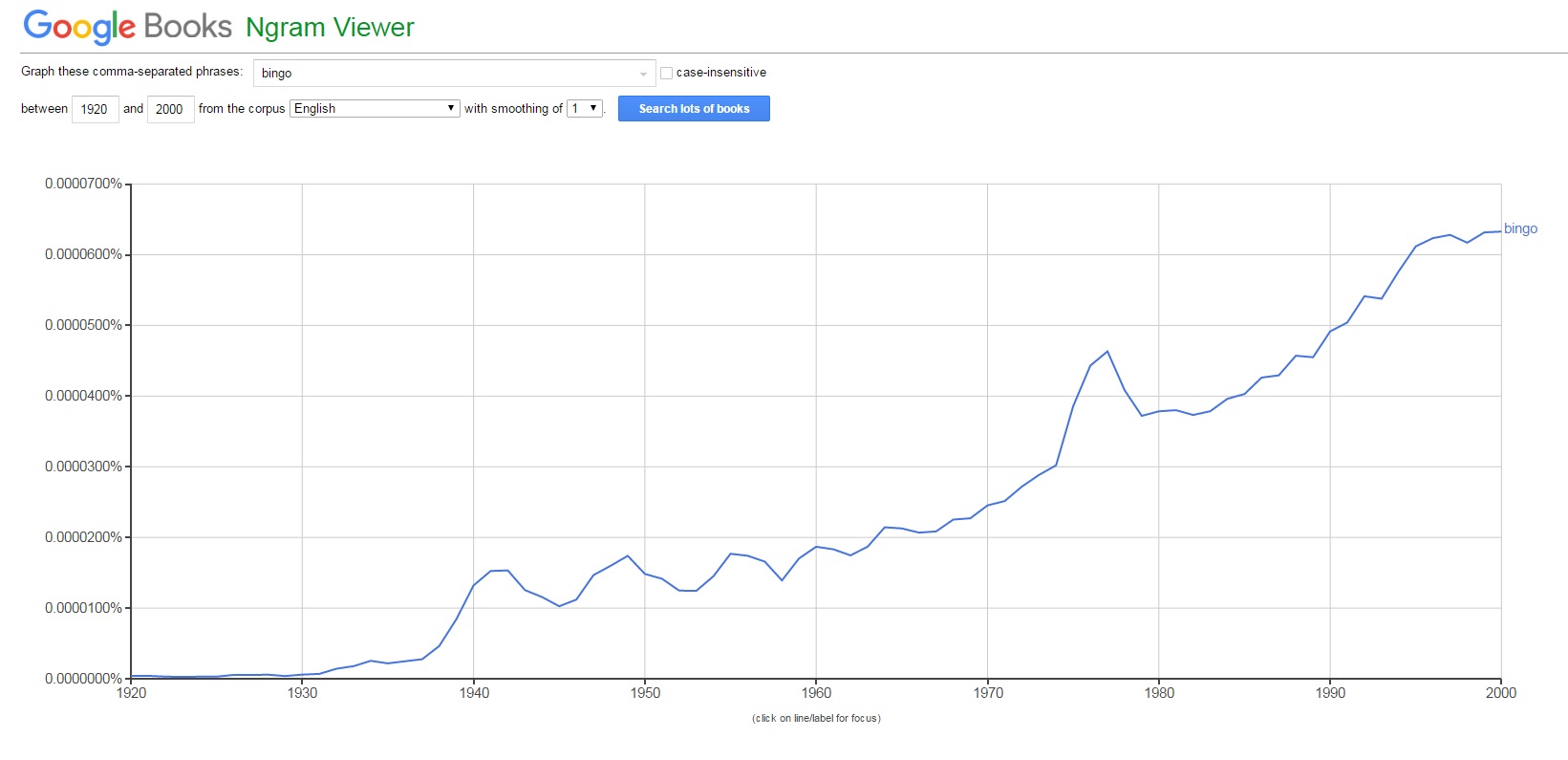
This is where Google Books’ Ngram Viewer can be helpful.  It uses the collective bajillion-zillion words scanned by Google Books and charts them by year published. You can use it to chart a word or phrase’s popularity in all of GoogleBooks 450 million scanned published works.  It’s not definitive and may not perfectly reflect normal conversation, but it is certainly helpful to see how frequently the word was used in print. I does not include newspapers, which would be *very* useful if it would.

It turns out 1930-something isn’t a great time for the word Bingo.  It was around and was used earlier, according to this chart, but has been climbing in popularity since then. The true high-water mark came in 1976, apparently.  I have no idea why that would be, but that’s for someone else to chase.  I have a story to get back to.

Bingo

Like this post? Here’s more about historical research:
How to know Things are Bound to get Worse
H
ow to Research History like a Novelist


Powered by Buttondown.

About the Author: Benjamin L. Clark writes and works as a museum curator.

Noir Renaissance?

A Noir Renaissance?

Probably the best essay I’ve read on noir fiction in a very long time, addressing the whiteness of noir, and the potential of its resurgence, making the point that noir has a place in protest literature.  I think it absolutely has that chance, but not many writers take it.  I certainly haven’t, but it’s something I’ll think about.

Nicholas Seeley, the author of the article, gives a good definition of noir stories as well:

By “noir,” I mean something more than a general tone of bleakness and dysfunction. … Anglo-American fiction evolved in the grip of a controlling public morality, which demanded the representation of behavior only within certain socially acceptable lines. The classic crime story, the kind written by Sir Arthur Conan Doyle and Dame Agatha Christie, is the whodunit: it takes place in an essentially orderly universe, with a common understanding of good and evil. Crime here is a dangerous anomaly, but order can be restored by a hero-detective who investigates and, eventually, unmasks the criminal: revealing evil for what it is, giving it a physical location in an individual, and in the process, re-affirming the innocence of the other characters.

Noir, as it emerged in the middle of a violent century, said to hell with all that. Its world was chaotic, baroque and hypocritical. Crime doesn’t disturb this world, it’s foundational to it. Noir stories gave the stage to criminals and their motivations, which range from unspeakable passions to a firm conviction that their particular crime serves a greater good. A detective may pursue such a criminal, but noir reveals the line between them to be a product of chance and circumstance—if, indeed, such a line exists at all.

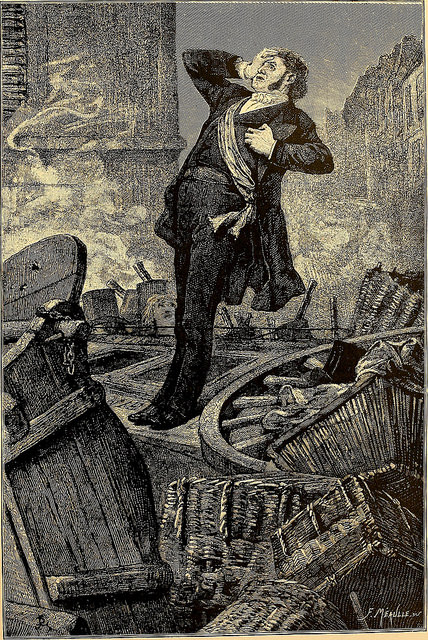
14781906401_f061cc033d_z
Courtesy The Internet Archive

WHY NOT SUBSCRIBE TO MY NEWSLETTER?

To new beginnings

Notebook and coffee

This is definitely not my first blog post.

I had a blog about book collecting and bibliophilia for many years over on blogger.  I’m active over on tumblr too, but that isn’t so much blogging as a constant stream of amusing/pretty/cool stuff.  I post a lot of photos and quotes and things I happen to like, (i.e. typewriters. I love me some typewriters.)  It’s more immediate too, so there will be music links and funny memes, you know, tumblr stuff. Here, I’ll share links to articles, tools, and especially historic research resources I find helpful.  I may occasionally post music to write to, or cool images.

Here, I’ll talk about my research, my writing, whatever I’m working on as I progress toward my writing goals.  What are those goals?  Well, in the short-term, I’ve managed to get a piece of flash-fiction placed with cool series from Akashic Books.  Next is to finish another short (but longer than flash) piece and get it placed somewhere.  Longer term, I’m working on what I’m seeing as a novella series, and then another series of full-length novels.  Both series are historic thrillers/mysteries. One of those series grabbed me by the collar and is dragging me along.

What I’m working on now: a novella set in and around 1930s Denver. I was not alive in the 1930s nor have I lived in Denver, so there’s some research to do.  This story also features a main character who I think will be a series character.  Anyway, the short has been a lot of fun, using info I’ve dug up previously, but haven’t used.

I’ve gotten to know the main character  in this one pretty well.  He first appeared as a supporting cast member of my first attempt at a novel back in 2007 or so.  Through edits, rewrites, and dumping the whole thing and starting over a couple times, he’s emerged as one of the two main characters of that novel — he was too fascinating, and too much fun to hang out with compared to my original main character.

Why not subscribe to my newsletter?

Anyway, thanks for reading.  No spoilers, but amazing poster served as a bit of inspiration this week:

h0849-l93439607

Book Review: The Murder of Mary Russell by Laurie R. King


 I’ve just finished The Murder of Mary Russell.  Wow.  It’s … fantastic. I get nervous with Laurie R King’s new books in her beloved Mary Russell – Sherlock Holmes series.  This is book 14 of the long-running series.  Sure, I love some books of the series better than others … but this book was marvelous and absolutely the follow-up I needed (as a fan) after Dreaming Spies, Garment of Shadows, and (deep breath), The Pirate King.
After a deadly confrontation, readers are drawn through the history of one of Sherlock Holmes’s earliest cases and the true background of the fascinating Mrs. Hudson(!), and the true nature of her relationship to Sherlock.   We even get a bit of King’s take on a Sherlock Holmes not long before his arrival at Baker Street.  I know I could read a *lot* more in that vein.  Maybe someday King will give us a little more.
About half-way through this latest of the series, I had an idea that though I was enjoying it, The Murder of Mary Russell would only appeal to the die-hard fans of Mary Russell and maybe those true completists of Sherlock pastichery.  And a few unbranded #histofic mavericks.  After all, we’re delving deep — real deep, into the supporting cast of the series, usually territory for only the most devout readers of fanfic and scholars of minutia.  However, after that half-way mark (or so), all that build up became more and more meaningful, reaching deep into the story of King’s Sherlock, which incidentally, is among my favorite interpretations.
We’re also (mostly) but not entirely back in London and Sussex for this tale.  If you’re among the legions of King’s readers who love the globe-trotting nature of Russell and Holmes’s lives, you shouldn’t feel too cooped up, after sojourns at sea and a bit of time in Australia during the days of Transportation and gold.
So, a spoiler free review, given how little I can tell you, given that title.  Yikes.  Read The Murder of Mary Russell and see how the world of Sherlock and Mary Russell is changed forever.
Disclosure: I received a free advance ebook copy for review.
.

Book Review: Jane Steele by Lyndsay Faye

Book Review: Jane Steele by Lyndsay Faye

“Reader, I murdered him…., A reimagining of Jane Eyre as a gutsy, heroic serial killer….”
With a lead-in like that, I had high expectations.  That and this is Lyndsay Faye we’re talking about, the creator of the marvelous Timothy Wilde series, and the one who finally gave us a gripping account of Sherlock Holmes vs. Jack the Ripper that frankly is better than anything Conan Doyle would have come up with.  
Jane Steele is a fun, action-filled homage to the Gothic triple deckers of the Victorian age.  It has the classic tropes:  Girl orphaned young, named Jane, abused by the wealthier kinfolk she lives with, sent away to horror-show school and becomes governess …  I go into books labeled ‘reimaginings’ with gun-shy wariness.  Like satire, it can be a fine line between brilliant and obnoxious, too cute or cloying.  Steele is not a satire of the genre, but it is sly and winking, more like a quiet unspoken joke between old friends.   Jane Steele is even published as a triple decker — thankfully under one cover.  It’s action-filled and just tons of fun with some great characters I deeply hope to see again.    
Steele, is also unflinching from the ugliness in ugly people, and hardships of the time.  Some of that ugliness is only hinted at in those classic Gothic novels we love, but here if someone is a sexual predator, it’s said/shown.    
Anyone shying away from the ‘serial killer’ tag — I think it’s not used well here.  Jane Steele isn’t a serial killer.  More like a vigilante, or frankly just someone who lives in hard place during a hard time.  The violence is largely unflinching, but far from Tarantino-esque.  This isn’t a cozy knitting mystery, but I think the majority of readers won’t be put off by the violence.
Faye’s descriptions are gold, building tension then giving readers that pinching little twist of anticipation making payoffs that much sweeter.  Book to book, she just gets better and better.

Christmas List 2016 started

It’s not secret, 

really enjoyed the Blake & Avery series of historic thrillers by historian M.J. Carter last year. And my (not so) idle curiosity went ahead and tweeted the author herself when one could expect Blake & Avery 3 —– 
It wasn’t entirely presumptuous on my part she was working on it, she’s tweeted before that the manuscript was underway.  
So, this is what I learned:

image
So, there we have it.  It will hopefully be a later 2016 release, and not need to be put off further still.  Until then, I hope M.J. Carter feels better!
.

Book Review: The Infidel Stain by MJ Carter


It’s been three years since Jeremiah Blake and bibliophile William Avery teamed up in India for what was one of the most enjoyable books I’ve read recently (The Strangler Vine) — getting in on the ground floor as it were of a new series.  The Infidel Stain takes us to London in the early 1840s, into the orbit of publishers and pornographers, dissidents and rebels.  Oh, and of course, murder.  It’s one of those novels that just oozes with atmosphere of dank and dark London, after a terrifying time in the dangerous jangals of India. Our heroes have become something of celebrities given their encounter with Xavier Mountstuart.  We learn a little more about the mysterious Jeremiah Blake’s background in this novel, which was interesting, to say the least.  We don’t get much more of Avery, which I would have enjoyed.  Maybe the only thing I’d have expected was that ardent bibliophile William Avery, on a rare visit to The City would indulge himself in a visit to a bookshop.

Historically rich, and textured, a thriller that had me reading late in huge gulps.

Ok, an admission: I liked the first book better.  But with reports of Blake & Avery 3 well underway, I can’t wait to see what happens next. This book was published as The Printer’s Coffin in the United Kingdom.

Like this?  Subscribe to my newsletter.

Book Review: Station Eleven by Emily St. John Mandel

station_eleven_cover
We read Station Eleven aloud, and … wow.  My partner now wants to read more post-apocalyptic stuff (I recommended: Alas, Babylon).  We follow the intertwining strands of several people’s lives who experience a nearly extinction level pandemic in the near future.  I didn’t find it overly gruesome the way some books in the genre go, though there is death and injury, and other unsettling events, as anyone would expect.  The book does a lot of slipping and sliding in the timeline, but these shifts are handled deftly by Emily St John Mandel.  The post-apocalyptic chapters and scenes largely take place 20 years after the pandemic, which is very interesting.  If you’re at all interested, I know you’ll look at more reviews, and have probably already heard of this book.  I’m just adding my voice to the choir singing its praises.  It’s a creepy, beautiful, touching story about family, survival, and at its core: art.  I loved it.

Enjoy this post?  Why not subscribe to my newsletter?